How to Choose a Stretch Ceiling Profile: Selection Guide
Profile selection guide for stretch ceilings: decision criteria (mounting method, room height, membrane

06.04.2026 | Interior Inspirations, Profiles for Stretch Ceilings
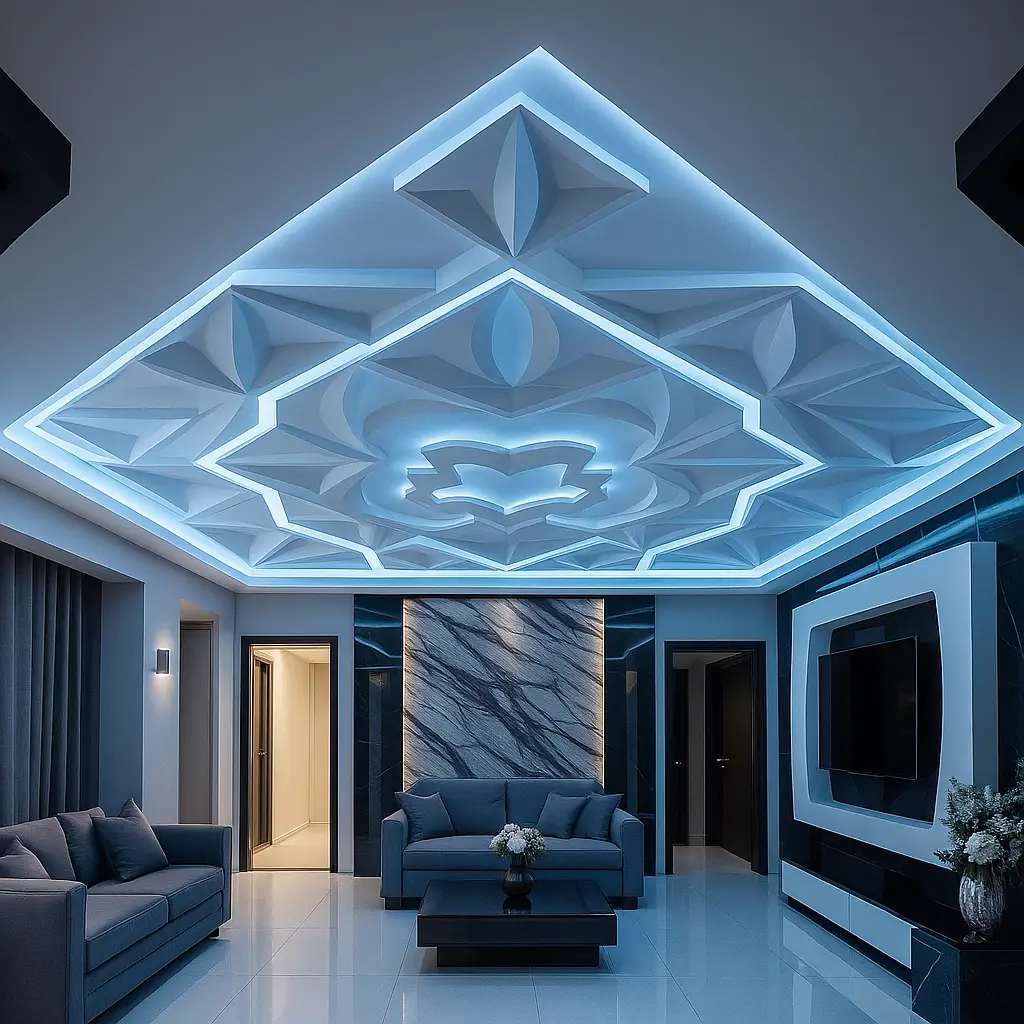
Stretch ceilings are one of the fastest-growing segments of interior finishing across Europe. The technology relies on stretching a flexible membrane over an aluminium perimeter frame to achieve a perfectly smooth ceiling surface without any wet plastering. In this guide we cover membrane materials, surface finish types, the installation process step by step, and the real advantages and limitations of stretch ceilings from a professional installer’s perspective.
A stretch ceiling is a finishing system consisting of two components: a membrane (PVC film or polyester fabric) and a perimeter mounting profile. The membrane is secured in the profile using a harpoon, clip or wedge system, then tensioned thermally (PVC) or mechanically (fabric). The result is a smooth, uniform surface separated from the structural ceiling by a sealed cavity of 2-10 cm.
Stretch ceiling technology originated in France in the 1960s. Today it is used in both residential and commercial settings: hotels, offices, shopping centres, swimming pools and healthcare facilities.
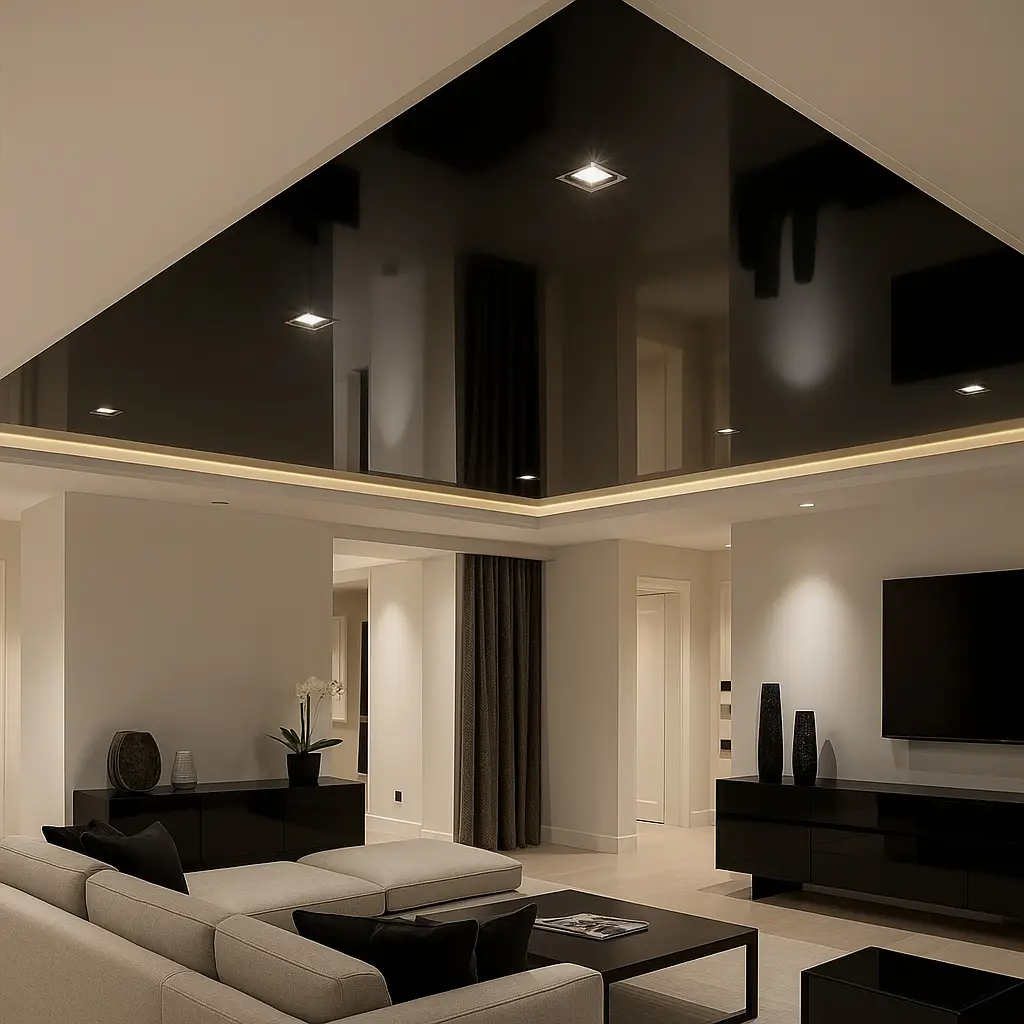
PVC (polyvinyl chloride) film is the most popular stretch ceiling membrane material. Available in thicknesses of 0.17-0.22 mm, it offers a wide range of surface finishes and colours. PVC membrane is fully waterproof, which is a significant advantage in wet areas and as flood protection from above.
| Parameter | PVC film | Polyester fabric |
| Thickness | 0.17-0.22 mm | 0.40-0.50 mm |
| Maximum width | Up to 5.1 m (seamless) | Up to 5.0 m |
| Water resistance | Full (up to 100 l/m2) | Partial (seeps through after 24-48 h) |
| Installation | Thermal (gas heater) | Mechanical (cold install) |
| Fire rating | Class B-s2, d0 (flame retardant) | Class B-s1, d0 |
| Removal and reinstallation | Yes (harpoon system) | Limited (clip system) |
| Finishes | Matte, glossy, satin, printed | Matte, UV printed |
Polyester fabrics (e.g. Clipso, Descor) are a premium material used where vapour permeability or cold installation is required. Fabric does not need heating, which simplifies installation in rooms with sensitive equipment. The downsides are higher cost and a narrower colour range compared to PVC.
The choice of membrane finish affects the visual result, light reflection and perception of space. Below are the four principal types.
A matte finish imitates a smoothly plastered ceiling. It does not reflect light, eliminating glare and mirror effects. Ideal for bedrooms, offices and rooms where a calm, uniform surface is desired. Matte PVC membranes have a light reflectance of approximately 30%.
Glossy membranes have a reflectance of up to 90%, creating a mirror-like effect. They visually enlarge the room and increase interior brightness. Frequently used in living rooms, hotel lobbies and commercial spaces. Note that a glossy surface exposes any unevenness in profile mounting, so precision installation is essential.
A compromise between matte and glossy. Satin membranes have a soft, silky sheen with a reflectance of about 50-60%. They work well in restaurants, consulting rooms and representative spaces where an elegant effect without aggressive reflections is desired.
UV and latex printing technology allows any graphics to be applied to the membrane: sky with clouds, starry night, geometric abstractions or art reproductions. Print resolution reaches 1440 dpi and colours are fade-resistant. Printed membranes are most often used in hotels, restaurants, spas and children’s rooms.
Installing a PVC stretch ceiling requires proper preparation and equipment. Below are the stages of installation using the harpoon system, which is the most common in Europe.
Precise room measurement to within 5 mm accuracy. Based on the measurement the manufacturer cuts the membrane and welds a harpoon (PVC keder) around the perimeter. Lead time: 3-7 working days. Calculations and quotations can be prepared with dedicated software available from 2K-Trade.
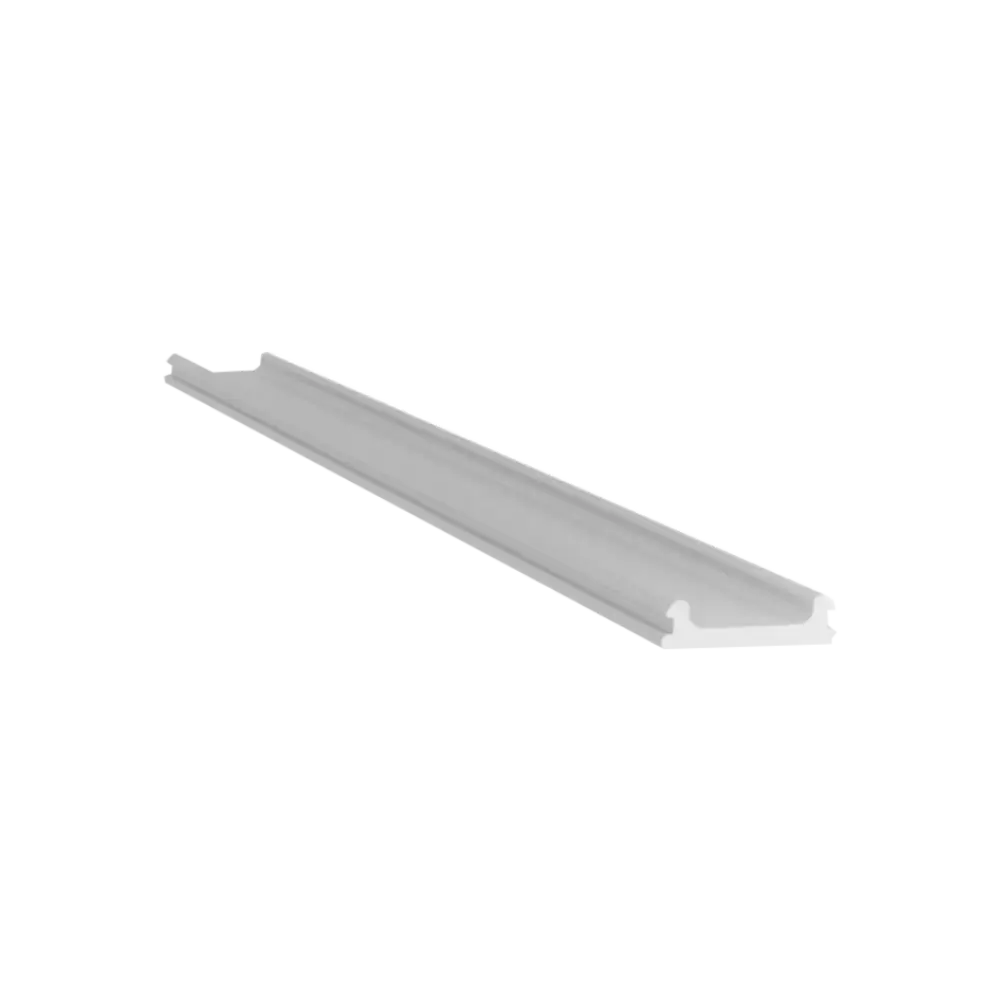
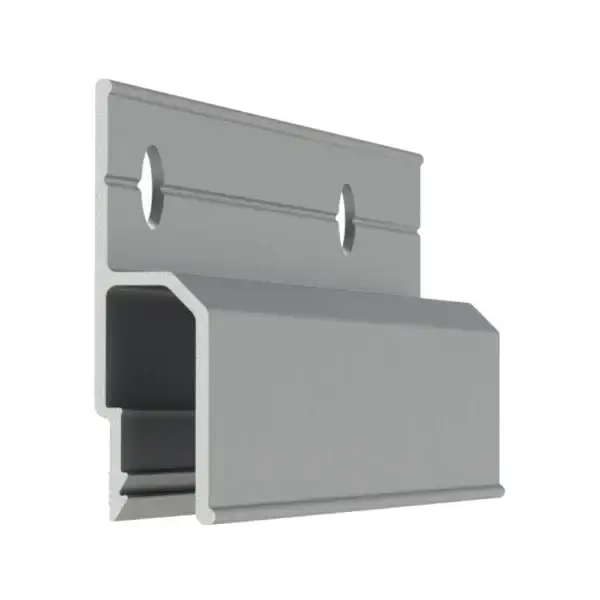
Aluminium profiles are fixed to walls or ceiling using wafer head screws and steel angle brackets. Fixing centres: every 10-15 cm. Profile level is set using a rotary laser. The profile type (wall, ceiling, universal) depends on room conditions and membrane type.
Before stretching the membrane, platforms for spotlights, chandeliers and fire sensors are installed. Platforms are fixed to the structural ceiling with adjustable hangers, and their lower edge must be exactly level with the membrane.
The PVC membrane is heated to 60-70 °C with a gas heater. The heat makes the film flexible so it can be inserted into the profile using specialist installation spatulas. As the membrane cools it shrinks and tensions, creating a perfectly smooth surface.
After tensioning the membrane, decorative trim inserts are fitted to conceal the gap between the profile and the wall. Then openings for light fittings are cut and reinforcing rings are applied.
| Sector | Typical applications | Recommended finish |
| Homes and apartments | Living rooms, bedrooms, bathrooms, kitchens | Matte, satin |
| Offices | Open plan, conference rooms, receptions | Matte with acoustic perforation |
| Hotels and restaurants | Lobbies, banquet halls, corridors | Glossy, satin, printed |
| Healthcare | Consulting rooms, corridors, operating theatres | Matte (easy disinfection) |
| Pools and spas | Pool halls, saunas, relaxation zones | Polyester fabric (vapour permeable) |
| Retail | Shops, shopping centres, showrooms | Glossy, printed (branding) |
A stretch ceiling is the ideal base for modern lighting systems. The cavity between the membrane and the structural ceiling hides wiring and controllers, while translucent membrane enables back-lighting effects.
A professional stretch ceiling installation requires a complete set of components. In the 2K-Trade catalogue you will find everything you need:
How much does a stretch ceiling cost per square metre? The price depends on the membrane type, finish and installation complexity. Approximate figures: matte PVC membrane is 40-80 EUR/m2 installed, polyester fabric 80-150 EUR/m2. Prices exclude lighting and non-standard constructions.
Is a stretch ceiling suitable for a bathroom? Yes. PVC membranes are fully waterproof and mould-resistant. They are used in bathrooms, pool areas and kitchens. Polyester fabrics have limited moisture resistance.
How do you maintain a stretch ceiling? A microfibre cloth and warm water with a mild detergent are sufficient for regular cleaning. Do not use abrasive agents or solvents.
Can a stretch ceiling be installed in a room with underfloor heating? Yes. The stretch ceiling is not affected by underfloor heat. However, the temperature in the ceiling zone should not exceed 50 °C.
How long does installation take? A standard 20 m2 room with spot lighting: 3-5 hours. Multi-level constructions with light lines: 1-2 days.
Can the membrane be replaced without removing the profiles? Yes, in a harpoon system the membrane is replaceable. Simply heat it, remove it from the profile, and install a new one.
Stretch ceilings combine aesthetics, functionality and fast installation in one solution. The choice between PVC film and polyester fabric, between matte and glossy finish, between wall and ceiling profile — each decision influences the final result. In the 2K-Trade catalogue you will find a complete range of aluminium profiles, accessories and LED lighting for professional stretch ceiling installation.
Profile selection guide for stretch ceilings: decision criteria (mounting method, room height, membrane
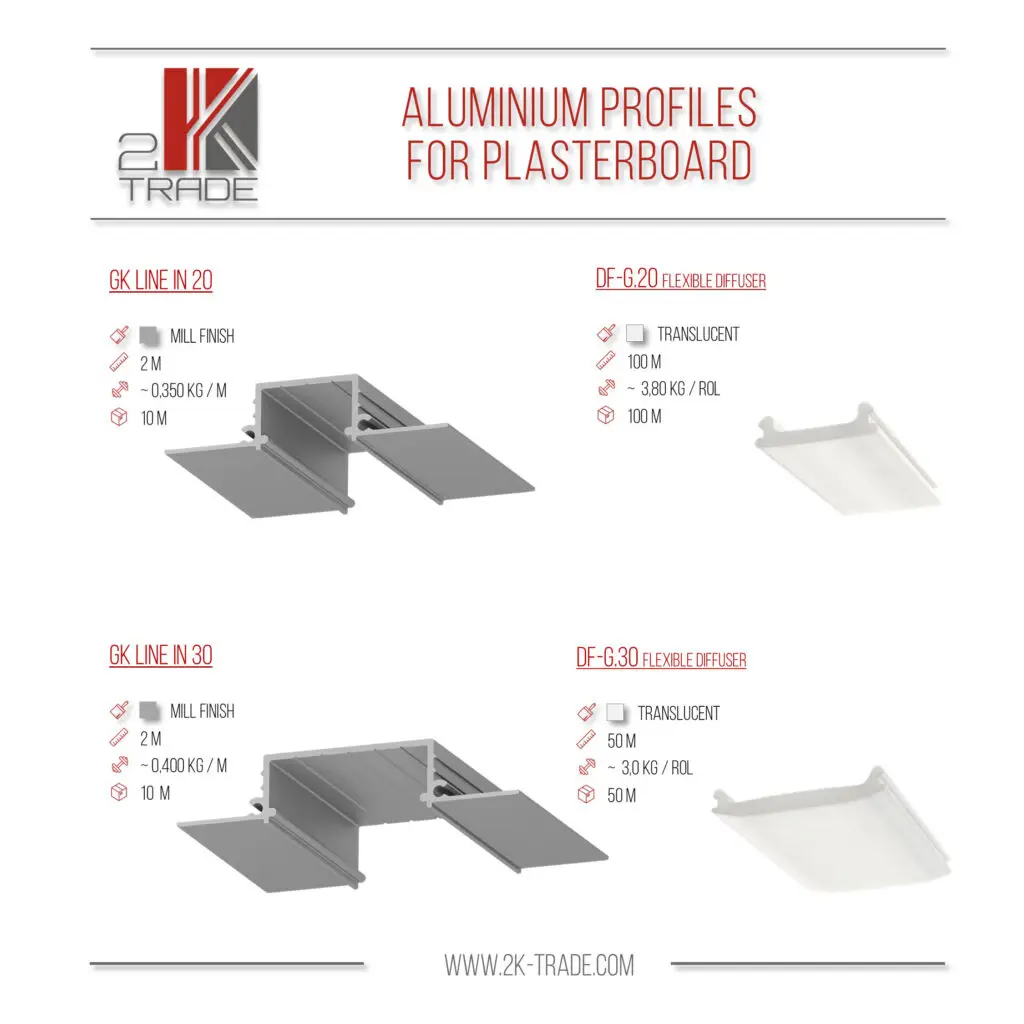
Guide to recessed LED profiles: types (GAMMA series for stretch ceilings, GK LINE
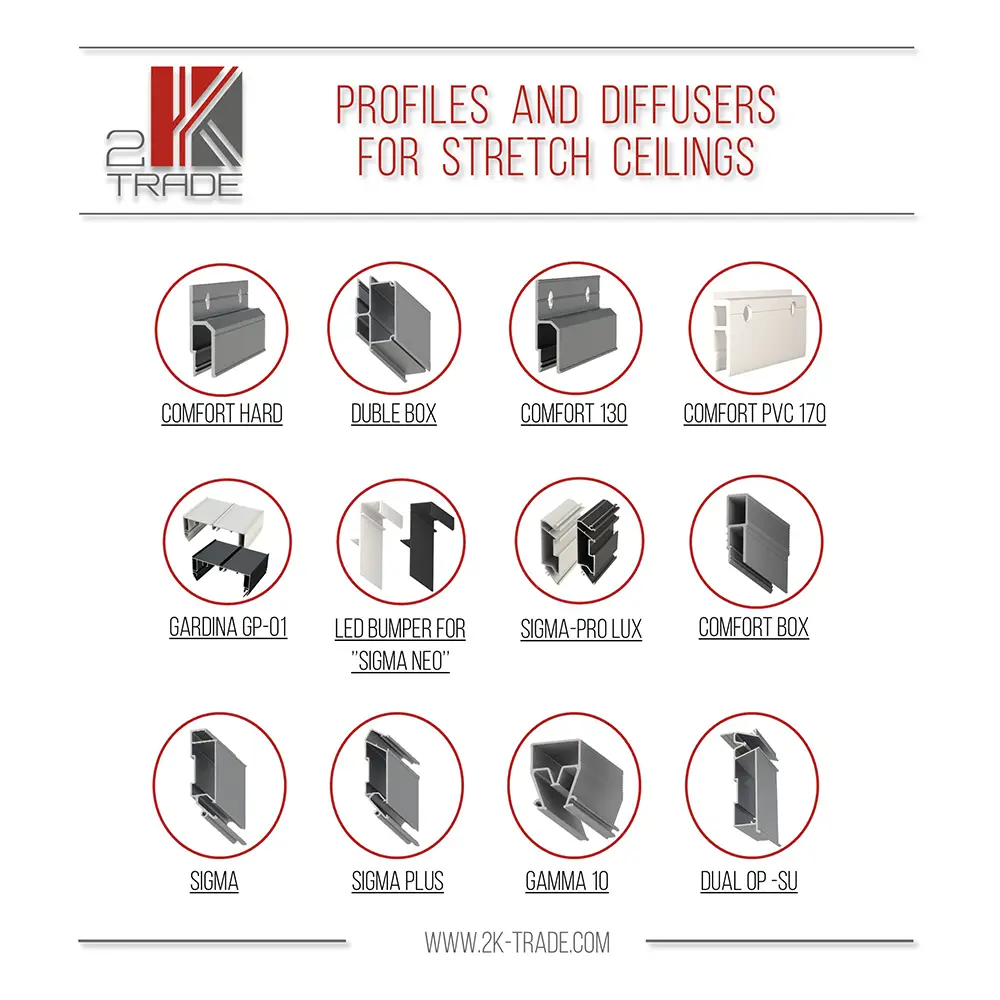
Complete catalogue of stretch ceiling profiles: CLASSIC, COMFORT, DELTA series, ceiling-mount SU variants,
Cart is empty
Go to shop