Recessed LED Profiles: Types, Installation and Component Selection
Guide to recessed LED profiles: types (GAMMA series for stretch ceilings, GK LINE

25.07.2025 | LED Lighting
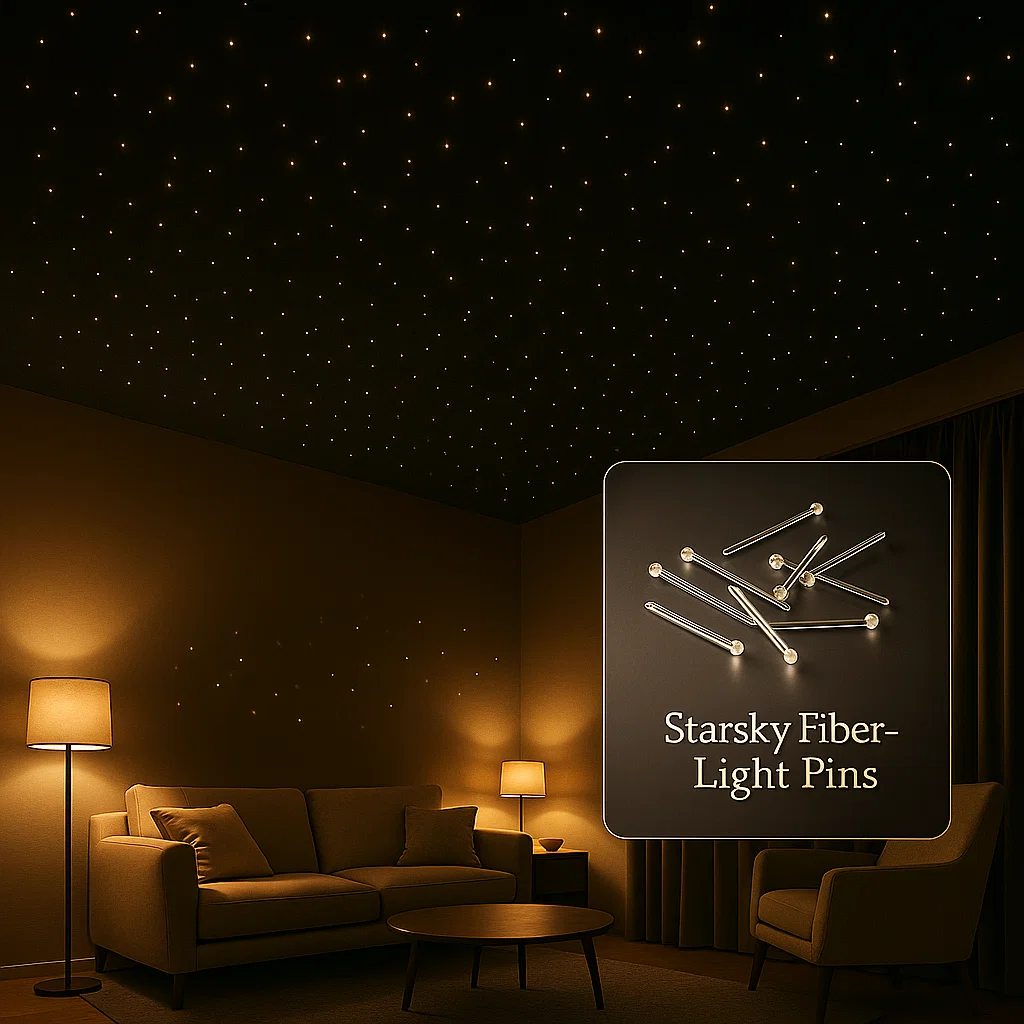
Fibre-optic LED lighting is an innovative decorative solution that gives any interior a distinctive atmosphere. The most popular use is the „starry sky” effect, but the technology has a far broader range of applications. Below we explain how the system works, what its key advantages are and how you can put together a project like this on your own.

In a conventional system the light is produced by a bulb or LED located directly at the point where it is visible. Fibre optics work in a fundamentally different way: a single light source – usually an LED illuminator – generates the light, which is then carried to many points along thin optical fibres. The fibre tips are the only visible parts of the installation; they can shimmer subtly to give a soft, diffused glow or recreate a sparkling night sky.
The system is more than just visually striking – it removes many of the limitations of traditional lighting. Because there is no current and no heat at the fibre tips, the solution is exceptionally safe even in damp or demanding environments. A single source can serve hundreds of light points, which significantly reduces energy use. You can also pair the fibres with a colour-changing illuminator, opening the door to dynamic and atmospheric lighting scenes.
Starry-sky effect
Most often used in bedrooms, children’s rooms, living rooms and relaxation areas, ceilings of this kind imitate a clear night sky and create a calming atmosphere. Delicate points of light spread across a dark background give a striking impression of depth and space.
Decorative details
Optical fibres can also be arranged as hanging light curtains, as chandeliers that look like falling threads of light, or as discreet outlines along stair edges, walls and floors.
Wet and demanding spaces
Because the fibres carry no electrical current, the technology is well suited to bathrooms, saunas and even underwater applications in swimming pools. The illuminator is installed away from the moist area, while the light itself reaches places that conventional fixtures simply cannot access safely.
Natural daylight from outdoors
Systems that channel sunlight into building interiors are becoming increasingly common. The optical fibres collect daylight from outside and deliver it to spaces with no windows, for example – an environmentally friendly and people-friendly solution.
Creating a starry ceiling does not require electrical expertise or expensive specialist tools. With a ready-made fibre-optic kit and a little patience you can produce an impressive result in your own home. Here is the project step by step:
1. Choose the right kit
The market offers complete sets containing a light source (LED or halogen) and a bundle of optical fibres in various lengths and diameters. Depending on the effect you want, you can choose a kit with 100, 300 or even 500 fibres. Transparent end caps or small crystals are an interesting addition that intensifies the sparkle of the „stars”.
2. Plan the layout of the stars
Before you start the installation it pays to sketch out a rough layout of the light points. You can opt for a random distribution to achieve a natural look, or recreate real constellations. Transfer the plan onto the ceiling surface itself with a pencil.
3. Prepare the holes
At each marked point on the ceiling – plasterboard or stretch fabric, for example – drill or pierce small openings, typically around 1 mm in diameter. With stretch ceilings, a heated tool or a sharp point is used to puncture the membrane gently and cleanly.
4. Install the fibres
Thread the optical fibres through the prepared holes so the tips protrude slightly. If access to the space above the ceiling is limited, the fibres can also be fitted from below – for example by gluing them to the surface and concealing them with a finishing layer.
5. Secure and trim
Once all the points are in place, secure them from inside the room with a drop of silicone or epoxy adhesive – that is enough to hold the fibres in position. After the glue has cured, trim the excess fibre, ideally cutting at varying angles so that the stars shine with different intensities.
6. Install the light source
Gather the other ends of all the fibres and feed them into the illuminator. Mount the unit in a ventilated location – above the suspended ceiling, inside an enclosure or in an adjacent room. Make sure the device remains accessible in case servicing is ever required.
7. Done!
Once the illuminator is switched on, a full starry panorama appears across the ceiling. With colour and effect changes, no two evenings need to look the same. Settle in and enjoy your private piece of the cosmos.
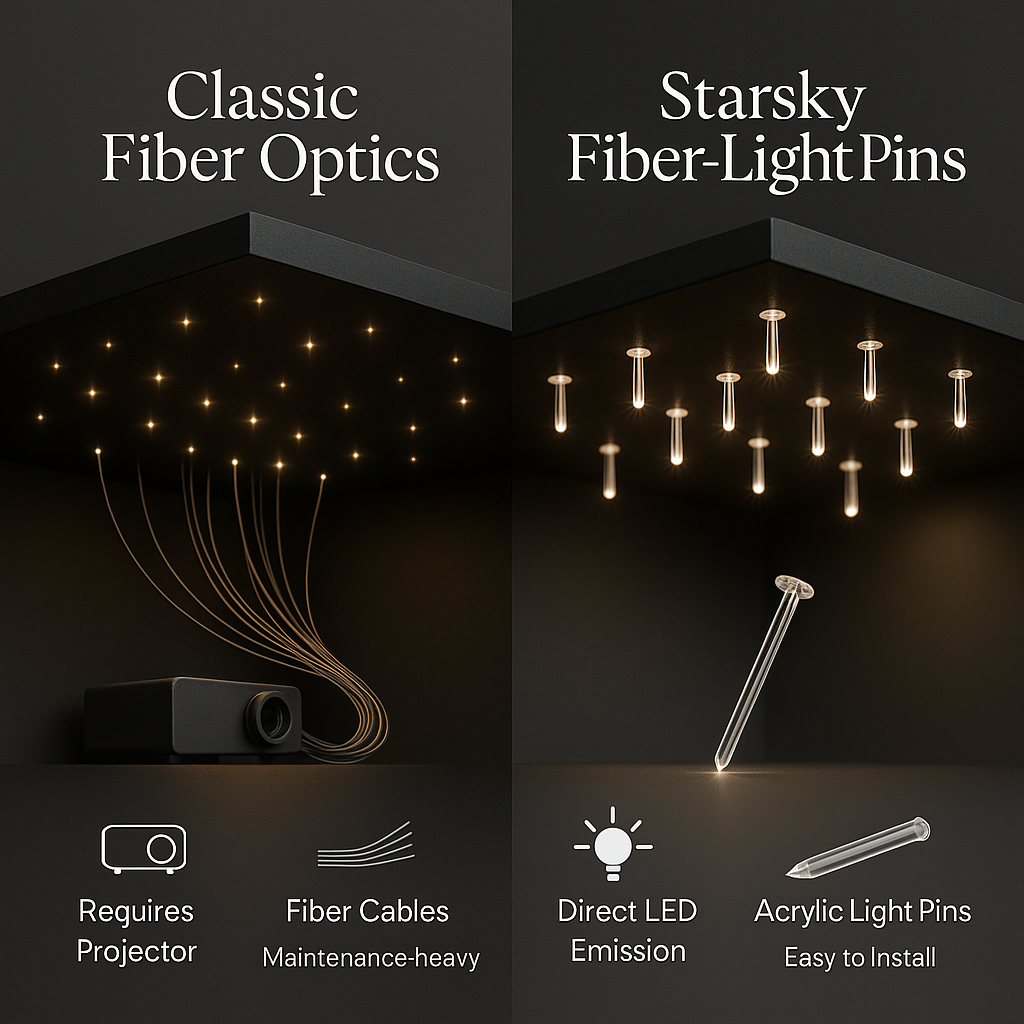
Although classic fibre optics remain unmatched for decorative point lighting, the technology continues to evolve and new options keep appearing. Today you can produce a „starry sky” effect in more than one way.
The classic approach – proven quality
For years, fibre optics have been the choice of interior architects and enthusiasts of contemporary design. They prove their worth wherever safety (no current at the visible tips), moisture resistance, precision and the ability to power thousands of light points from a single source are required. They are an excellent fit for swimming pools, saunas and bathrooms, where conditions are tough on conventional bulbs and LED strips.
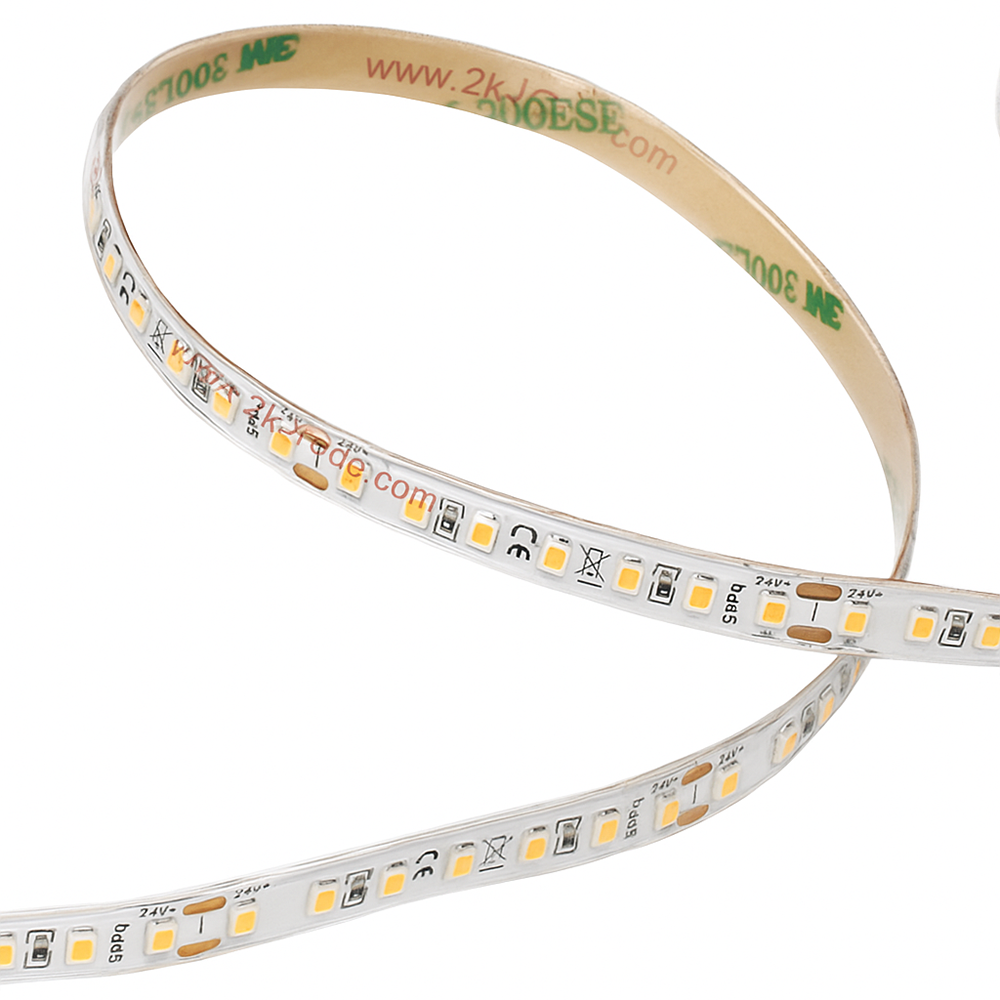
Modern solutions such as the Starsky fibre-optic pins from 2K-Trade deliver an equally striking result with a far simpler installation. Instead of a separate illuminator, all you need is an LED strip mounted above the ceiling. Each pin captures the light from the strip and releases it discreetly at the tip, mimicking the effect of a twinkling star.
The main advantage of this system is its shallow installation depth – around 5 cm – which means you can fit it even where there is no room for a classic fibre-optic illuminator. No specialist tools or prior experience are required, making it the ideal choice for anyone who wants a quick, attractive result without a complicated build.
If you are planning installations in demanding conditions, classic fibre optics remain the right choice. For residential interiors, where speed of installation and budget are key, LED pins are well worth considering. Both technologies have their strengths and prove their value in different settings, allowing you to bring a captivating night-sky effect into your home.
Fibre-optic lighting is more than decoration – it is a way to give a space a character all its own. Whether you dream of a private planetarium in the bedroom, a relaxing ceiling above the bathtub or discreet lighting around a swimming pool, this technology gives you complete creative freedom.
Just as important are the safety in everyday use, the energy efficiency and the ability to fine-tune the effects to your own taste. All of this explains why fibre optics are now appearing not only in luxury interiors but increasingly in private homes. And thanks to modern LED alternatives such as the Starsky pins, even people with no installation experience can transform the look of their ceiling with ease.
Whichever method you choose, the „starry sky” effect is sure to impress and to stay in your memory for a long time to come.
Is DIY installation difficult?
No. Most fibre-optic kits are designed specifically with home users in mind. A little care and patience are all you really need – no specialist tools or electrical know-how are required.
Does this kind of lighting use much energy?
Quite the opposite. Both classic LED illuminators and LED pin systems are highly energy efficient. A single illuminator can power several hundred light points, and LED strips combine very low power draw with strong light output.
Can fibre optics be installed in damp rooms?
Yes – in fact this is where they perform best. The fibre tips carry no current and stand up well to water and high temperatures. The illuminator is placed in a dry location, and the fibres are routed into the sauna, bathroom or pool.
Are there cheaper alternatives to traditional fibre optics?
Yes. The Starsky LED pins are a modern solution that does not need a separate illuminator. They are fitted into the ceiling and connected to an LED strip – the visual result is very close to the classic system, but the installation is far simpler and faster.

Guide to recessed LED profiles: types (GAMMA series for stretch ceilings, GK LINE
LED aquarium lighting requires specific spectral output to support aquatic life. Freshwater planted
LED ceiling lighting refers to systems using LED strips, modules, or panels installed