COB and Digital 24V LED Strips: Technology, Models and Applications
COB (Chip-on-Board) and digital (addressable) 24V LED strips are two product categories expanding

06.04.2026 | LED Strips and Modules
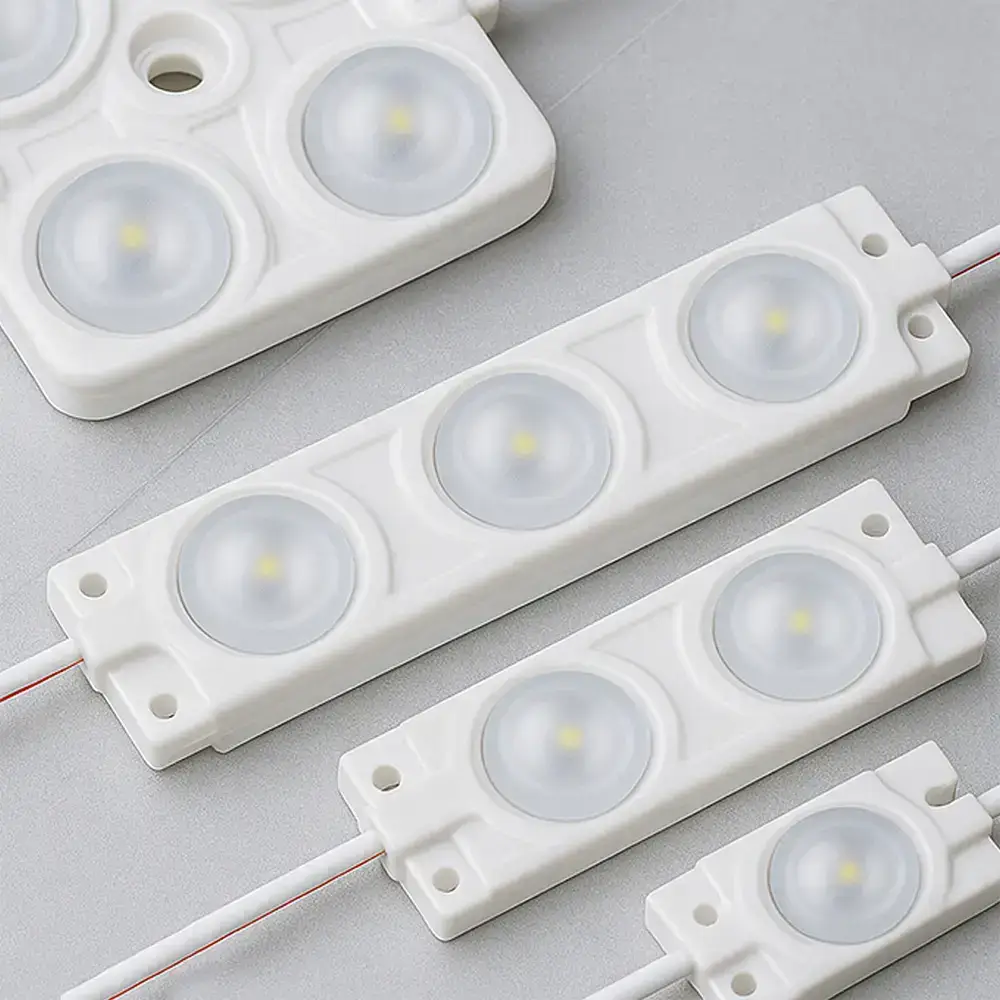
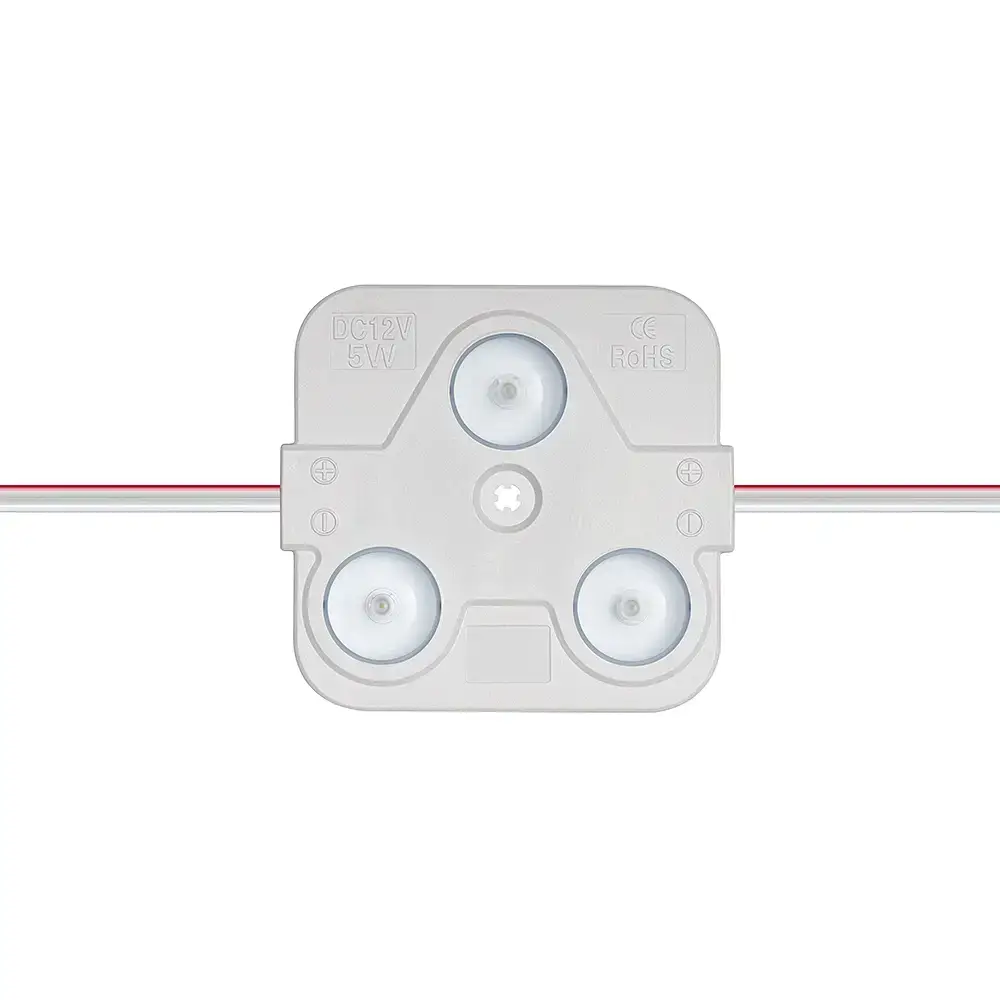
LED modules are self-contained light sources consisting of one or more LEDs mounted on a PCB (printed circuit board). Each module contains an LED chip, a current-limiting resistor, and optionally a lens to direct the light beam. Modules are connected in chains via power cables and mounted using 3M self-adhesive tape.
Unlike LED strips, modules are point sources — each module emits light independently. This makes them the optimal solution for backlighting large surfaces (stretch ceilings, sign boxes) and three-dimensional objects (3D letters, signage), where a linear strip cannot provide even light distribution.
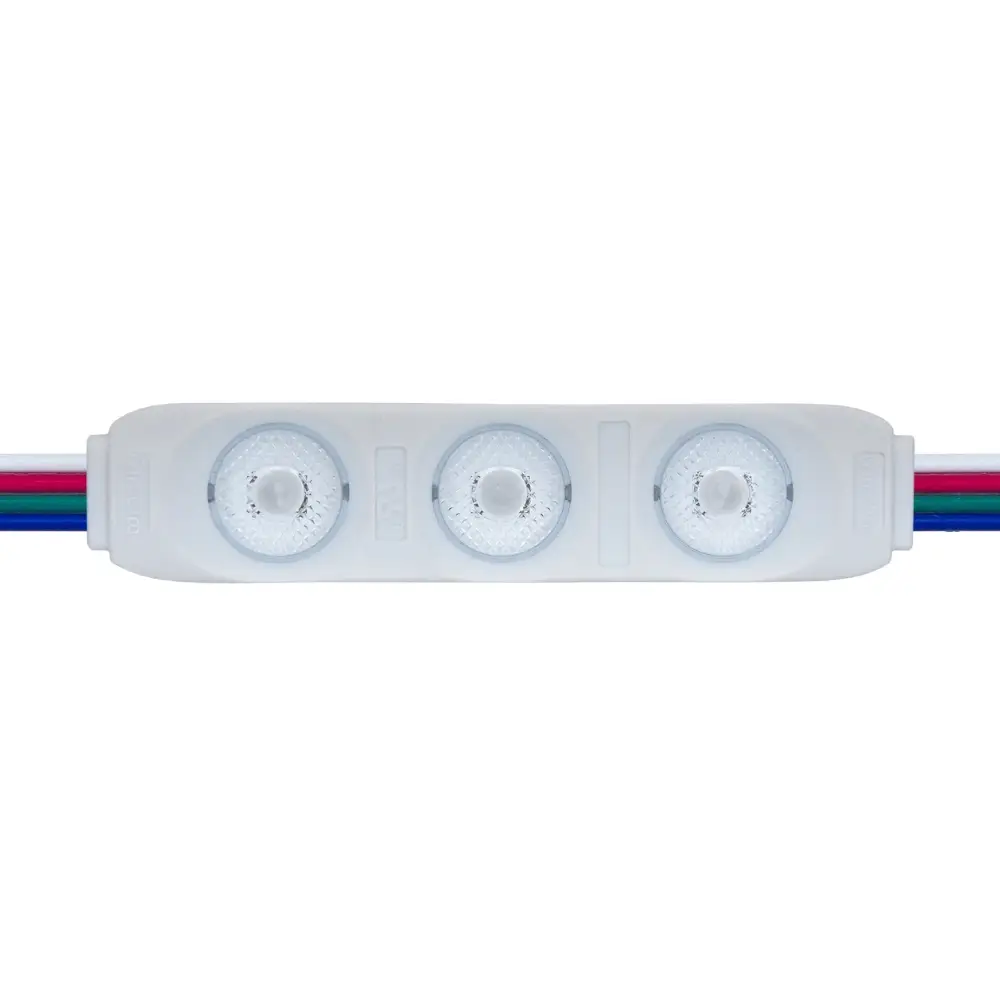
The 2K-Trade LED modules catalogue includes six series differing in power, beam angle, and colour temperature.
MINI LED modules are the smallest in the range, designed for backlighting thin sign boxes and small surfaces. Parameters:
HIGH EFFICIENCY LED modules deliver high luminous flux at low energy consumption. Suited for applications requiring intense backlighting:
POWER LED modules are the highest-output series, designed for backlighting large surfaces from a distance:
UNI CCT LED modules offer tuneable colour temperature in the 2700-6500 K range via a CCT controller. Each module contains two LED types (warm and cool), enabling smooth colour temperature transitions:
RGB Lens and RGBW Chip modules produce full-spectrum colour light. RGBW modules include an additional white LED, enabling colour mixing with white light:
| Series | Power (W/module) | Beam angle | CCT | Backlighting depth |
|---|---|---|---|---|
| MINI | 0.36-1.0 | 170 | 3000/4000/6000 K | up to 80 mm |
| HIGH EFFICIENCY | 1.0-1.5 | 160 | 3000/4000/6000 K | 80-200 mm |
| POWER | 2.0-3.0 | 15-60 | 3000/4000/6000 K | over 200 mm |
| UNI CCT | 1.5 | 160 | 2700-6500 K (tuneable) | 80-200 mm |
| RGB Lens | 1.0-1.5 | 160 | RGB | 80-200 mm |
| RGBW Chip | 1.5-2.0 | 160 | RGBW | 80-200 mm |
LED modules are the primary light source for light-box stretch ceilings. They mount on the ceiling slab at even spacing (typically 50-100 mm) and light passes through a translucent membrane. Lens modules ensure even light distribution across the entire ceiling surface, eliminating visible hot spots.
For standard-depth backlighting (100-200 mm), use HIGH EFFICIENCY modules. For greater membrane-to-slab distances (over 200 mm), use POWER modules with directional lenses.
LED modules are the industry standard for backlighting light boxes, signs, and 3D letters. Directional lenses enable even backlighting even at shallow box depths (40-80 mm). IP65-rated modules (available in some series) can be used for outdoor installations.
LED modules are used for backlighting furniture recesses, curved installations, and architectural elements where LED strips cannot deliver even results. Point-source mounting allows custom light distribution matched to the shape of the backlit object.
Correct LED module installation requires the following rules:
| Criterion | LED modules | LED strips |
|---|---|---|
| Light type | Point source | Linear |
| Surface backlighting | Even across large areas | Even along a line |
| Backlighting depth | 40-300+ mm | 30-150 mm (with profile) |
| Placement flexibility | Any point layout | Straight line or curve |
| Typical application | Light-box ceilings, sign boxes | Perimeter lighting, stairs |
| Mounting | 3M tape on surface | 3M tape in aluminium profile |
In many projects, modules and strips are used together: modules on the ceiling plane (light-box backlighting) and strips in LED profiles around the room perimeter (light line).
A complete LED module backlighting system consists of:
For standard light-box backlighting at 150 mm depth: 80-120 modules per square metre (80-100 mm spacing in both directions). At greater depth (over 200 mm), density can be reduced to 40-60 modules/sq m using POWER modules with directional lenses.
Yes, all 24V LED modules can be dimmed using PWM controllers. MONO controllers adjust brightness of single-colour modules, CCT controllers tune colour temperature of UNI CCT modules, and RGB/RGBW controllers manage colour on colour modules.
Rated lifespan is 30,000-50,000 hours. At continuous 24/7 operation, that is 3.4-5.7 years. At typical usage (8-12 hours/day), modules last 7-17 years. Mounting on a metal surface (e.g. ceiling sheet metal) extends lifespan through better heat dissipation.
Modules rated IP65 or higher are moisture-resistant and can be used outdoors. For indoor applications (stretch ceilings, sign boxes in dry rooms), IP20 modules are sufficient. Check the IP rating in the product data sheet for each series.
Calculate: (number of modules) x (module wattage) x 1.2. Example: 200 HIGH EFFICIENCY modules x 1.2 W x 1.2 = 288 W. Choose a supply rated at least 300 W with 24V DC output. 2K-Trade stocks Mean Well power supplies from 20 W to 600 W.
The complete LED modules catalogue includes six product series in various power, colour temperature, and IP rating options. All modules operate on 24V DC and carry CE certification. B2B orders are fulfilled from the Lodz warehouse. Contact us for a project quote.
COB (Chip-on-Board) and digital (addressable) 24V LED strips are two product categories expanding
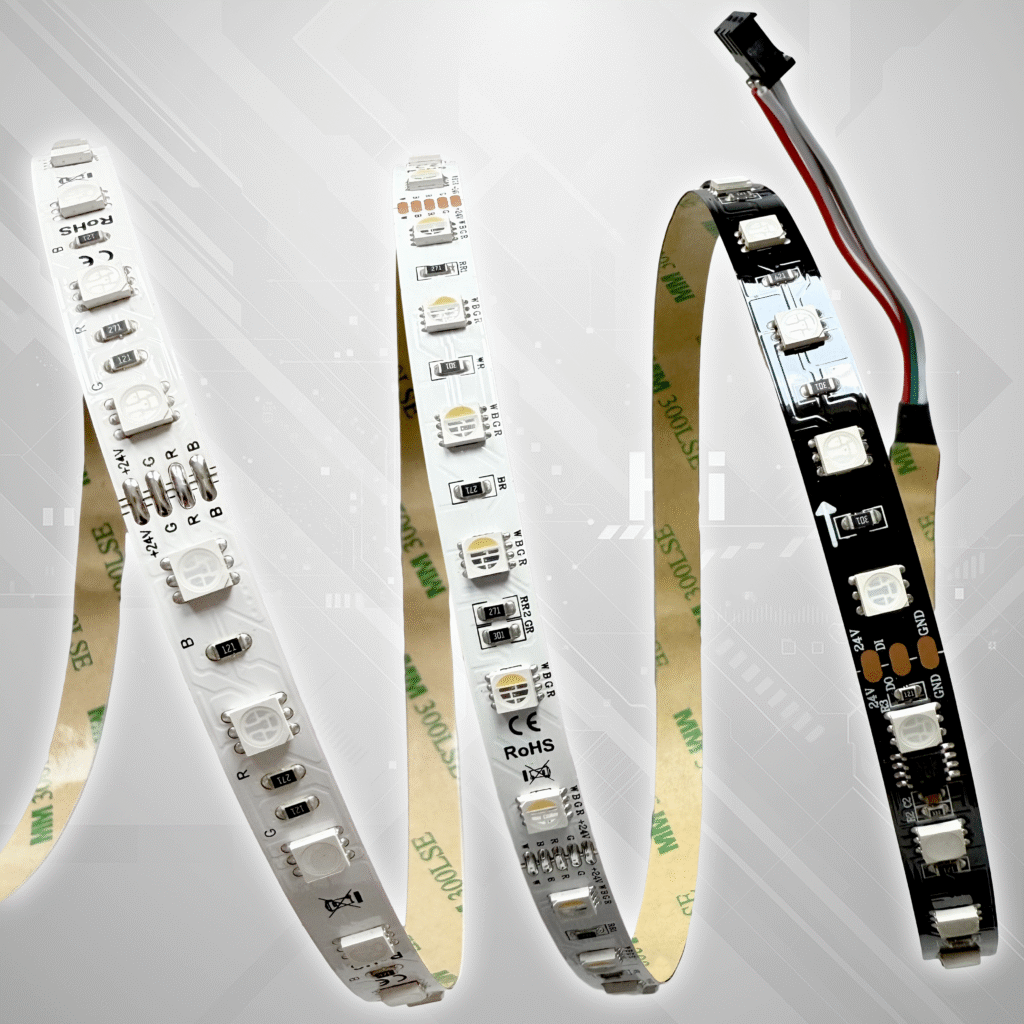
Latest-generation LED strips from 2K-Trade — COB, addressable digital, RGB/RGBW, tuneable CCT and