LED Modules: Types, Technical Parameters and Backlighting Applications
LED modules are compact light sources with LEDs mounted on a PCB board,

06.04.2026 | LED Strips and Modules
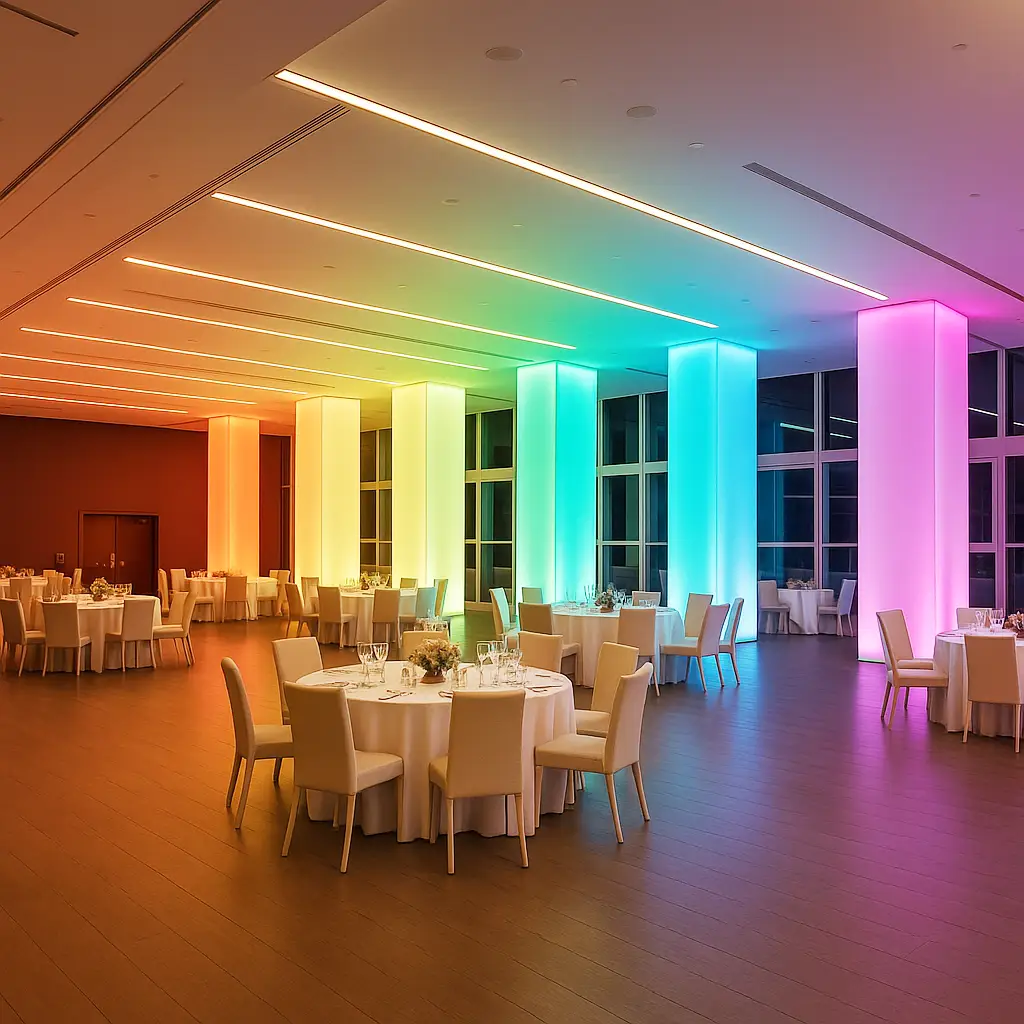
COB and digital 24V LED strips are two technologies transforming the way linear lighting is designed in stretch ceilings, furniture, and commercial spaces. This article presents the technical differences between COB, SMD, and digital strips, details the parameters of individual models, and explains which solution works best for specific applications.
Three LED strip technologies differ in construction, light output, and application. The choice depends on project requirements: budget, light quality, and the need for individual segment control.
| Parameter | SMD 2835 | COB | Digital (addressable) |
|---|---|---|---|
| Construction | Discrete LEDs on PCB | LEDs covered with phosphor, continuous line | LEDs with built-in IC chip |
| LED density/m | 120-192 | 320-784 | 60-630 |
| Light effect | Visible dots (uniform with diffuser) | Uniform light line without dots | Independently controlled segments |
| Power (W/m) | 4.8-20.0 | 10.0-21.0 | 11.0-21.0 |
| Control | Entire strip simultaneously | Entire strip simultaneously | Each segment individually (SPI/DMX) |
| Application | Universal, budget-friendly | Premium, open profiles | Dynamic effects, installations |
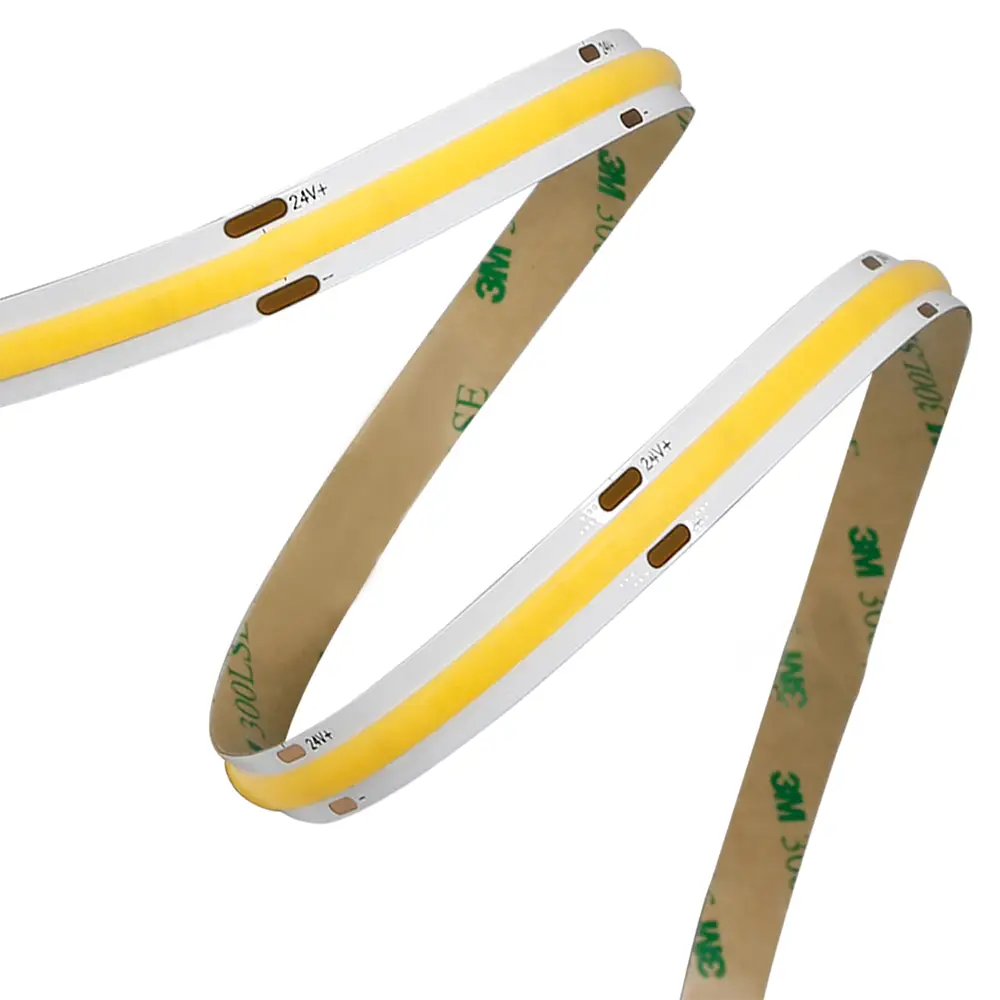
COB (Chip-on-Board) technology places LED chips directly on the PCB substrate and covers them with a shared phosphor layer. The result is a continuous, uniform line of light with no visible dots — even without a diffuser. This is the key advantage over SMD strips, which require a frosted diffuser to achieve an even glow.
COB LED strip models available from 2K-Trade:
| Model | LED/m | Power (W/m) | Colour/CCT | PCB (mm) | IP |
|---|---|---|---|---|---|
| COB 320 LED/m | 320 | 10.0 / 14.0 | 3000K / 4000K / 6000K | 8 / 10 | IP20 |
| COB CCT 608 LED/m | 608 | 16.0 | CCT 2700-6500K | 10 | IP20 |
| COB RGB 576 LED/m | 576 | 14.0 | RGB | 10 | IP20 |
| COB RGBW 784 LED/m | 784 | 19.0 | RGBW (W: 4000K or 6000K) | 12 | IP20 |
COB 320 LED/m strips are a versatile choice for LED profiles with an open or clear diffuser. The CCT 608 LED/m model allows smooth colour temperature adjustment from warm white (2700K) to cool white (6500K) using a single CCT controller.
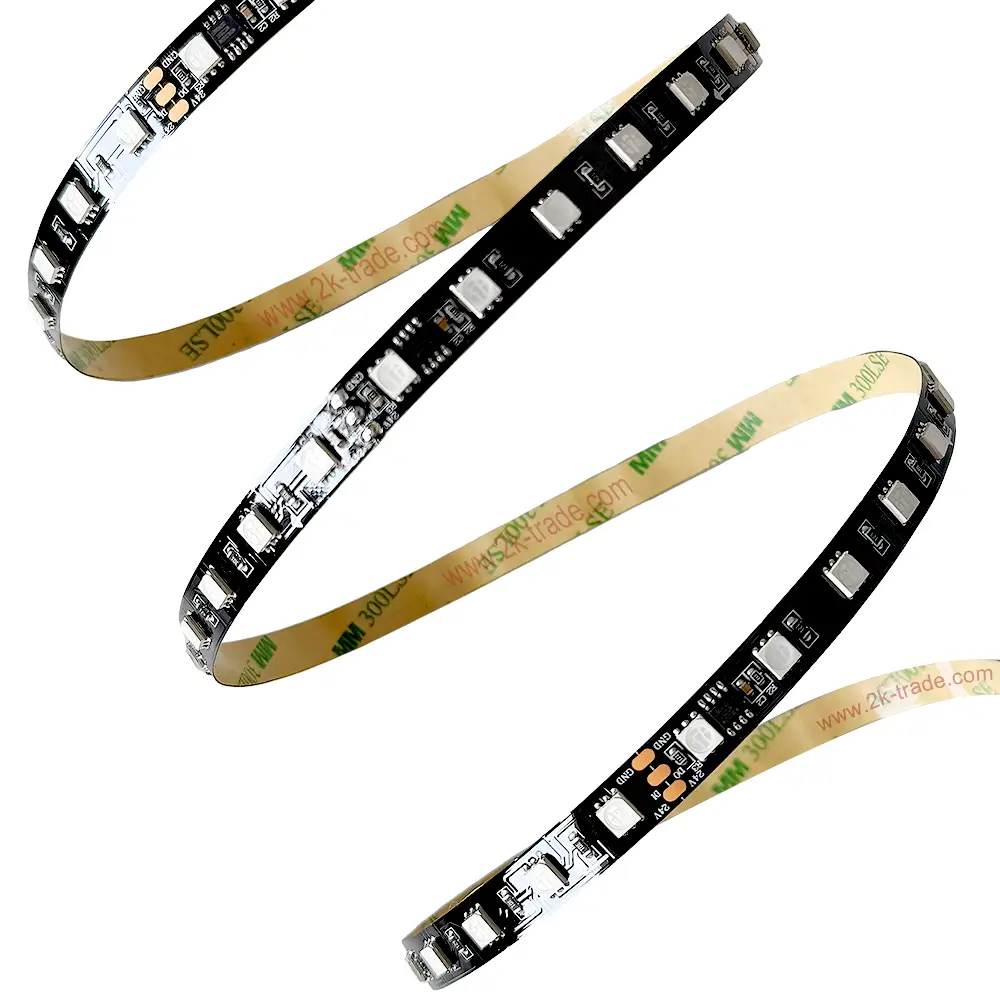
Digital (addressable) LED strips contain built-in driver ICs that enable independent control of each segment or individual LED. The communication protocol is SPI (Serial Peripheral Interface), with WS2811 being the most common IC. Digital strips require a dedicated SPI controller — a standard RGB or CCT controller will not work.
Digital LED strip models available from 2K-Trade:
| Model | LED/m | Power (W/m) | Colour | IC | IP |
|---|---|---|---|---|---|
| Digital WS2811 60 LED/m | 60 | 14.4 | RGB | WS2811 | IP20 |
| Digital COB WS2811 360 LED/m | 360 | 11.0 | Mono (3000K/4000K/6000K) | WS2811 | IP20 |
| Digital COB RGB 630 LED/m | 630 | 11.0 | RGB | IC 1814 | IP20 |
| Digital COB RGBW 784 LED/m | 784 | 21.0 | RGBW (W: 4000K or 6000K) | IC | IP20 |
Digital COB strips combine the advantages of both technologies: a seamless light line (COB) with segment-level control (digital). Models with 360 LED/m in mono versions (3000K, 4000K, 6000K) enable dynamic effects even with white light — such as sequential brightening in stretch ceilings or on stairs.
Digital strips require a controller that supports the SPI protocol. 2K-Trade stocks the SPIR3-M Mini Magic SPI controller — a compact 3-in-1 controller for mono, RGB, and RGBW strips. It features built-in effect programmes (running light, pulsing, rainbow gradient) and supports up to 1,024 pixels per output.
For more advanced installations (over 10 m of strip, multi-zone synchronisation), DMX512 controllers or Zigbee gateways such as the Mi-Light ZB-BOX3 are used.
SMD 2835 strips remain the most widely used type for linear lighting. They are cheaper than COB and digital strips, and with a frosted diffuser deliver an even light effect. 2K-Trade offers three variants:
In profiles with a frosted diffuser, the difference between SMD and COB strips is minimal. COB strips are justified where the profile has no diffuser or uses a clear one.
COB and digital strips work excellently with stretch ceiling profiles. Typical applications:
When selecting an LED strip for your project, consider these parameters:
Calculate power supply wattage: (strip length in metres) x (strip power in W/m) x 1.2 (20% headroom). Example: 10 m of COB 320 LED/m strip at 14 W/m requires a minimum 168 W supply. 2K-Trade stocks Mean Well LED power supplies from 20 W to 600 W, plus compact POW-TR 200W and POW-HHP 400W units for larger installations.
COB strips have LEDs covered with a shared phosphor layer, producing a continuous line of light without visible dots. SMD strips have discrete LEDs spaced several millimetres apart — the dot effect is visible without a diffuser. With a frosted diffuser, the difference is minimal.
Yes. Digital (addressable) strips require an SPI controller, such as the SPIR3-M Mini Magic. A standard RGB controller does not support the SPI protocol and cannot control individual segments.
For light lines in GAMMA profiles — COB 320 LED/m (uniform light). For perimeter glow in SIGMA-NEO profiles — SMD 2835 140 LED/m (economical, even effect with diffuser). For dynamic effects — digital COB strips.
COB strips generate comparable heat to SMD strips of the same wattage. The key is mounting in an aluminium profile, which dissipates heat and extends strip lifespan by 30-50%. Operating temperature in a profile: 35-55 degrees C.
Maximum single run without brightness loss is 5 m. For longer installations, use dual-end or parallel feeding. Power supply wattage must be 20% higher than total strip consumption.
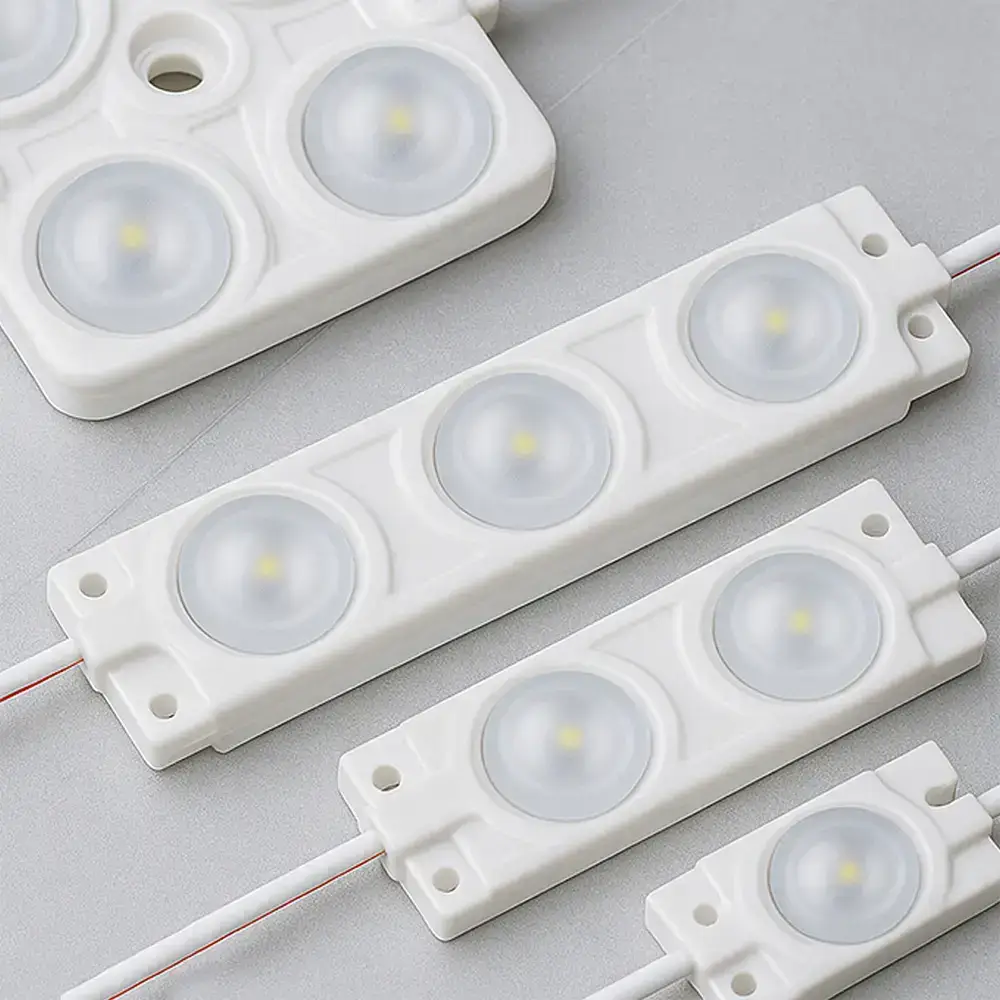
LED modules are compact light sources with LEDs mounted on a PCB board,
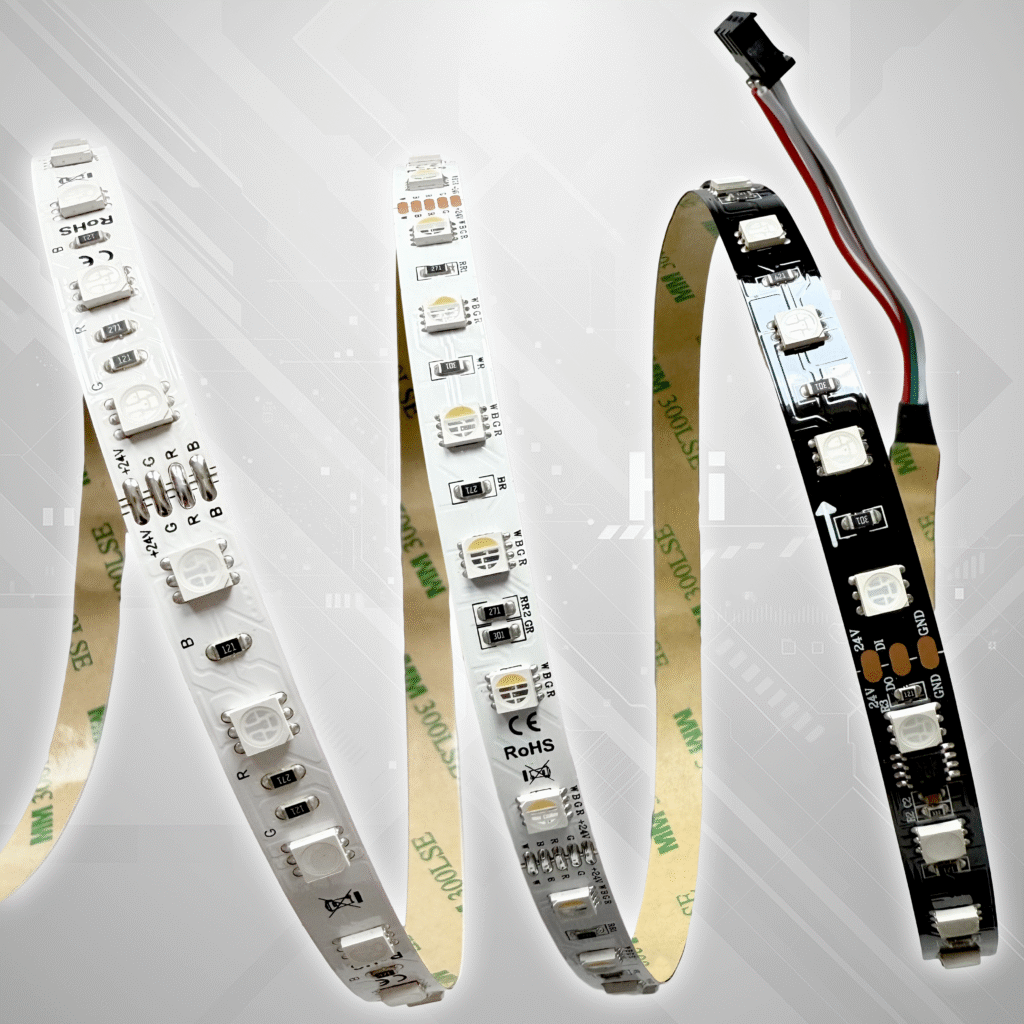
Latest-generation LED strips from 2K-Trade — COB, addressable digital, RGB/RGBW, tuneable CCT and